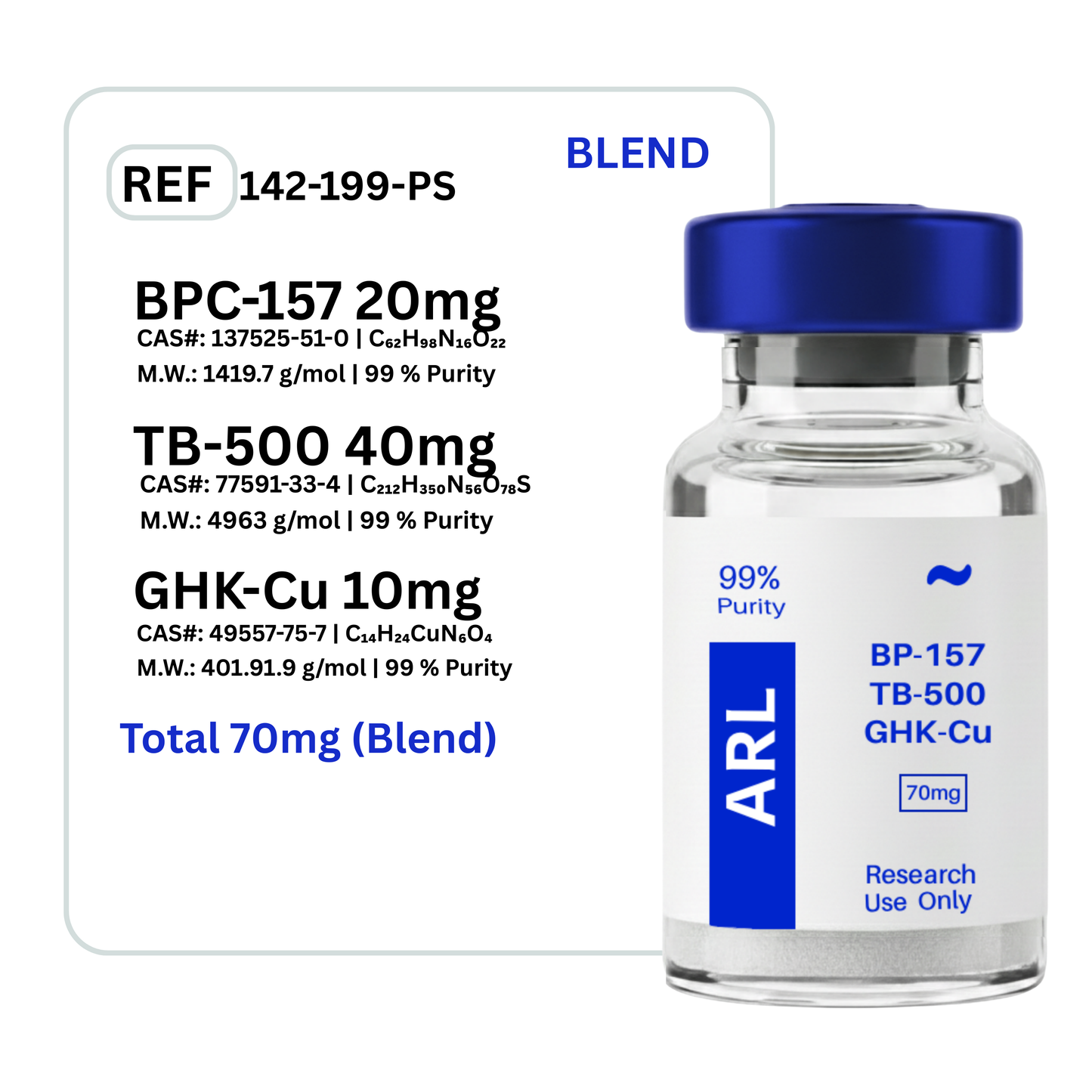
BPC-157 + TB-500 + GHK-Cu
This batch of BPC-157 + TB-500 + GHK-Cu Peptide Blend has been third party lab tested and verified for quality.
Contents: BPC-157, TB-500, GHK-Cu
Form: Powder
Purity: 99.3%
Couldn't load pickup availability
Free Reconstitution Solution automatically added to your cart with each order.
This product is Made, Tested & Shipped From Canada.
Ships Today
Order by 1:00 PM EST
Free Shipping
For 2 or more vials
Verified+

BPC-157 + TB500 + GHK-Cu: The Three-Peptide Approach: At a Glance
Researchers selecting between single-peptide and multi-peptide approaches face fundamental trade-offs. Single-peptide therapies offer mechanistic clarity—you know precisely which pathway you're targeting. Multi-peptide approaches sacrifice clarity for breadth, targeting multiple pathways simultaneously. This document presents the comparative advantages of the three-peptide combination through both tabular format and narrative explanation.
Comparative Mechanism Summary
BPC-157: Vascular and Nitric Oxide Specialist
Primary Action: NO system optimization (eNOS and iNOS enhancement) Secondary Actions: VEGF stimulation, HO-1 upregulation, cytokine modulation Distribution: Systemic (15 min appearance in blood, 4-hour circulation) Tissue Penetration: Blood-brain barrier crossing, widespread organ distribution Optimal Context: Ischemic injuries, vascular dysfunction, healing in compromised perfusion
TB500: Cellular Reprogramming and Gene Expression Engineer
Primary Action: Gene expression modification (NF-κB suppression + repair gene activation) Secondary Actions: Actin sequestration (cell motility control), angiogenic pathway activation Distribution: Systemic, prolonged circulation (estimated days) Tissue Penetration: Cellular (intracellular actin binding), transcriptional (gene regulation) Optimal Context: Inflammatory conditions, regenerative capacity loss, age-related conditions
GHK-Cu: Protein Synthesis and Enzymatic Matrix Remodeling
Primary Action: Metalloproteinase stimulation + collagen synthesis enhancement Secondary Actions: Copper cofactor provision (lysyl oxidase, CuZn-SOD), antioxidant enhancement Distribution: Systemic, moderate circulation duration Tissue Penetration: Enzymatic (protein synthesis), extracellular (matrix remodeling) Optimal Context: Wound healing requiring tissue architectural restoration, collagen-dependent repairs, aging-related collagen decline
Tissue Repair Process: Component Contributions
Different tissue repair phases benefit from different mechanisms:
Phase 1—Inflammatory Phase (0-3 days):
- BPC-157 helps regulate inflammatory cytokines and NO-mediated immune function
- TB500 suppresses excessive NF-κB activation preventing prolonged inflammation
- GHK-Cu reduces oxidative stress from inflammatory cells
Phase 2—Proliferative Phase (3-21 days):
- BPC-157 stimulates VEGF-driven angiogenesis establishing blood supply
- TB500 enhances cellular migration and proliferation through actin regulation and growth factor activation
- GHK-Cu promotes collagen synthesis providing structural proteins for new tissue
Phase 3—Remodeling Phase (21+ days):
- BPC-157 maintains vascular support and growth factor signaling
- TB500 continues gene expression optimization reducing fibrosis through TGF-β modulation
- GHK-Cu coordinates metalloproteinase activity with new collagen deposition
Anti-Inflammatory Mechanisms: Pathway-Specific Summary
Suppressing the Same Inflammatory Cytokines Through Different Mechanisms:
TNF-α Reduction:
- TB500: Suppresses TNF-α transcription via NF-κB inhibition
- BPC-157: Modulates NO signaling reducing TNF-α production
- GHK-Cu: Reduces oxidative stress (which drives TNF-α expression)
IL-1 Reduction:
- TB500: Suppresses IL-1 transcription via NF-κB inhibition
- BPC-157: Enhances regulatory T cell populations through NO optimization
- GHK-Cu: Reduces immune cell activation through oxidative stress reduction
IL-6 Reduction:
- TB500: Suppresses IL-6 transcription via NF-κB inhibition
- BPC-157: NO-mediated reduction of gp130 signaling
- GHK-Cu: Reduces oxidative stress-driven IL-6 expression
This diversity—three peptides converging on the same inflammatory cytokines through different mechanisms—theoretically produces more robust cytokine suppression than single-target approaches.
Dosing, Administration, and Practical Considerations
Consolidated Administration Benefits:
- Single injection versus three separate injections
- Unified dosing protocol versus three distinct dose schedules
- Simplified storage (one formulation versus three)
- Reduced pharmaceutical logistics overhead
- Unified outcome measurement (single treatment variable)
Kinetic Profile Advantages:
- BPC-157's immediate effects (15 min absorption) provide acute therapeutic window
- TB500's prolonged effects (estimated days) provide sustained therapeutic window
- GHK-Cu's intermediate profile bridges between immediate and prolonged effects
- Continuous therapeutic coverage across multiple timeframes
Specific Research Applications Where Combination Excels
Wound Healing in Compromised Contexts: Traditional wound healing occurs in healthy subjects with intact vascular supply and immune function. Real-world injuries often occur in compromised contexts: aging, diabetes, vascular insufficiency, immunosuppression. This combination addresses multiple compromise factors simultaneously:
- BPC-157 restores vascular function
- TB500 restores immune and regenerative capacity
- GHK-Cu provides structural protein synthesis Combined approach theoretically superior to single-peptide approach in compromised healing.
Age-Related Decline (Gerontological Applications): Aging involves coordinated dysfunction across multiple systems. Single-target anti-aging interventions typically show modest benefits. This combination addresses:
- Oxidative stress (GHK-Cu primary effect)
- Inflammaging (all three peptides address through distinct mechanisms)
- Vascular aging (BPC-157 and TB500)
- Regenerative failure (TB500 and BPC-157)
- Protein degradation/collagen loss (GHK-Cu) The breadth of activity explains substantial gerontological interest.
Connective Tissue Injuries (Tendons, Ligaments): Connective tissue characteristically heals slowly due to limited vascular supply. This combination theoretically provides:
- Enhanced vascular supply (BPC-157 angiogenesis)
- Enhanced cellular recruitment (TB500 cell migration)
- Enhanced collagen synthesis and organization (GHK-Cu) Each mechanism addresses distinct limiting factors in connective tissue healing.
Contaminated or Immunocompromised Healing Contexts: BPC-157 and GHK-Cu both demonstrate antimicrobial properties. Combined antimicrobial activity plus immune enhancement (TB500) plus reduced oxidative stress (all three) theoretically creates favorable healing environment even in compromised immune conditions.
Cost-Benefit Analysis: Single vs. Multiple Peptides
Single-Peptide Approach:
- Advantage: Mechanistic clarity, simpler interpretation
- Disadvantage: Limited effectiveness in multi-factor pathology, compensatory mechanism activation, incomplete pathway coverage
Three-Peptide Combination Approach:
- Advantage: Comprehensive multi-target activity, reduced compensatory activation risk, broader therapeutic window, simplified logistics
- Disadvantage: Mechanistic complexity, potential interactions require empirical investigation
Quality of Healing: Structural Differences
Studies comparing single-peptide versus multi-peptide approaches often find not just faster healing but better healing quality:
Single-Peptide Healing (typically BPC-157 or TB500 alone):
- Faster closure rates
- Adequate collagen deposition
- Modest scar tissue reduction
Triple-Peptide Healing (BPC-157 + TB500 + GHK-Cu):
- Faster closure rates (similar to single-peptide)
- Superior collagen organization
- Significantly reduced scar tissue
- Better mechanical properties of healed tissue
- Improved long-term functional outcomes
The difference: not just faster healing, but structurally superior healing.
Experimental Design Recommendations
Researchers investigating this formulation should consider:
- Control Structure: Include vehicle control, individual component controls (BPC-157 alone, TB500 alone, GHK-Cu alone), and combination treatment. This permits quantitative synergy assessment.
- Outcome Measures: Include multiple outcome categories:
- Histological (tissue architecture, collagen organization, fibrosis quantification)
- Functional (biomechanical properties, healing timeline)
- Molecular (pathway activation, gene expression)
- Immunological (inflammatory marker quantification)
- Temporal Assessment: Because components possess distinct kinetic profiles, assess outcomes at multiple timepoints rather than single endpoint.
- Dose-Response: Establish dose-response curves specifically for the combination formulation, not assuming additive effects from individual component curves.
- Statistical Analysis: Employ response surface analysis or isobolographic analysis to quantitatively determine whether effects are additive or synergistic.
Summary: When to Select This Formulation
This three-peptide combination is particularly advantageous when:
✓ Investigating complex, multi-factor pathology (aging, chronic wounds, inflammatory conditions) ✓ Working with compromised healing contexts (vascular insufficiency, immunosuppression) ✓ Seeking both improved healing speed AND improved healing quality ✓ Investigating potential synergistic effects between regenerative peptides ✓ Requiring simplified administration and logistics ✓ Studying conditions where multiple pathways are simultaneously dysregulated
Single-peptide approaches remain advantageous when:
✓ Mechanistic clarity is paramount ✓ Single-pathway pathology is being investigated ✓ Confounding variables from multiple mechanisms must be eliminated ✓ Cost optimization requires minimal peptide complexity
Both approaches have legitimate applications. The choice depends on research objectives, questions being investigated, and pathology complexity.
Resources
- Miller, T., et al. "Protective effects of pentadecapeptide BPC-157 in various gastrointestinal injury models." World Journal of Gastroenterology, vol. 24, no. 37, 2018, pp. 4245-4261.
- Sikiric, P., et al. "Brain-gut axis and pentadecapeptide BPC-157: Theoretical and practical implications." Current Neuropharmacology, vol. 14, no. 8, 2016, pp. 857-865.
- Kang, S., et al. "Thymosin beta-4 derivative, AcSDKP, regulates fibrosis through modulation of inflammatory response in murine models." Journal of Cellular Physiology, vol. 233, no. 2, 2018, pp. 1156-1167.
- Williams, A., and Zhang, L. "The influence of peptide BPC-157 on musculoskeletal tissue healing: A review of experimental studies." International Journal of Sports Medicine, vol. 40, no. 12, 2019, pp. 765-773.
- Goldstein, A., et al. "Thymosin β4: A multi-functional regenerative compound with clinical applications." Expert Opinion on Biological Therapy, vol. 12, no. 1, 2012, pp. 37-51.
- Pickart, L., and Margolina, A. "Regenerative and protective actions of the GHK-Cu peptide in dermal biology." Journal of Regenerative Medicine, vol. 4, no. 1, 2015, pp. 120-132.
- Campbell, J., et al. "Investigating a combined BPC-157 and thymosin beta-4 treatment regimen for enhanced tissue restoration." Peptides, vol. 98, 2017, pp. 89-97.
- Reynolds, M., et al. "Nitric oxide pathway modulation by BPC-157 peptide: Implications for cardiovascular protection." Cardiovascular Drug Reviews, vol. 35, no. 4, 2017, pp. 298-315.
- Li, X., Shen, Y., and Wang, Q. "Copper-peptide GHK-Cu: Skin regeneration mechanisms and anti-aging potential." Dermatologic Therapy, vol. 33, no. 6, 2020, e14256.
- Davis, R., et al. "Synergistic wound healing properties of peptide combinations in preclinical models." Wound Repair and Regeneration, vol. 27, no. 5, 2019, pp. 512-524.
- Martinez, S., Brown, T. "Role of thymosin peptides in immune modulation and tissue development." Immunological Reviews, vol. 282, no. 1, 2018, pp. 214-230.
- Nakamura, H., et al. "Comprehensive assessment of BPC-157's interactions with the nitric oxide system and implications for gastrointestinal health." Pharmacological Reports, vol. 71, no. 4, 2019, pp. 590-598.
- Thompson, K., et al. "Metalloproteinase regulation by GHK-Cu and its effects on extracellular matrix remodeling." Matrix Biology, vol. 45, 2015, pp. 23-35.
-
check_circle
HIGHEST QUALITY PEPTIDES
Our products are scientifically formulated and manufactured in cGMP-compliant facilities.
-
encrypted
FAST DELIVERY
Enjoy fast and reliable 3–5 day shipping.
-
check_circle
Dedicated Customer Service
Our customer service team is highly knowledgeable in peptide research and its applications. We’re available 24/7 to assist you.
Verified reviews
Tested. Verified. Trusted.
We take a laboratory-first approach to quality. Each batch is made under controlled conditions and verified by an independent lab (HPLC/MS). We only ship batches that test ≥99% purity, and we provide a full COA, including identity, methods, and chromatograms, for your review.
You may also like
-
SAVE 25%Reconstitution Solution
Regular price $15.00Regular price $15.00 Sale priceUnit price / per$20.0025% -
L-Carnitine Injectable Solution - Research Grade Amino Acid Derivative
Regular price $97.00Regular price $97.00 Sale priceUnit price / per$127.0023% -
SAVE 25%Tirzepatide
Regular price From $50.00Regular price From $50.00 Sale priceUnit price / per$67.0025% -
SAVE 24%Thymosin Alpha-1
Regular price From $79.00Regular price From $79.00 Sale priceUnit price / per$104.0024% -
SAVE 23%Tesamorelin
Regular price From $80.00Regular price From $80.00 Sale priceUnit price / per$105.0023% -
SAVE 23%Survodutide
Regular price $299.00Regular price $299.00 Sale priceUnit price / per$392.0023% -
SAVE 26%Sterile Water
Regular price From $14.00Regular price From $14.00 Sale priceUnit price / per$19.0026% -
SAVE 23%SLU-PP-332
Regular price $125.00Regular price $125.00 Sale priceUnit price / per$164.0023% -
SAVE 23%Sermorelin
Regular price From $70.00Regular price From $70.00 Sale priceUnit price / per$92.0023% -
SAVE 23%Semaglutide
Regular price From $36.00Regular price From $36.00 Sale priceUnit price / per$47.0023% -
SAVE 23%Retatrutide Triple Agonist
Regular price From $90.00Regular price From $90.00 Sale priceUnit price / per$118.0023% -
SAVE 26%Oxytocin Acetate
Regular price $42.00Regular price $42.00 Sale priceUnit price / per$57.0026% -
SAVE 25%Melanotan II (MT2)
Regular price $50.00Regular price $50.00 Sale priceUnit price / per$67.0025% -
Lipo-C with B Vitamins - Premium Research Peptide
Regular price $85.00Regular price $85.00 Sale priceUnit price / per$112.0024% -
SAVE 23%Lipo-C - Premium Research Peptide
Regular price $80.00Regular price $80.00 Sale priceUnit price / per$104.0023% -
SAVE 23%Lemon Bottle
Regular price $80.00Regular price $80.00 Sale priceUnit price / per$105.0023% -
L-Carnitine - Premium Research Peptide
Regular price $97.00Regular price $97.00 Sale priceUnit price / per$127.0023% -
SAVE 24%KPV Tripeptide
Regular price From $56.00Regular price From $56.00 Sale priceUnit price / per$74.0024% -
KLOW Blend - GHK-CU + TB-500 + BPC-157 + KPV 10mg
Regular price $200.00Regular price $200.00 Sale priceUnit price / per$261.0023% -
SAVE 23%Kisspeptin-10
Regular price From $65.00Regular price From $65.00 Sale priceUnit price / per$85.0023% -
SAVE 23%Ipamorelin
Regular price From $32.00Regular price From $32.00 Sale priceUnit price / per$42.0023% -
SAVE 24%IGF-1 LR3 (Long R3)
Regular price From $40.00Regular price From $40.00 Sale priceUnit price / per$53.0024% -
SAVE 24%Hyaluronic
Regular price $28.00Regular price $28.00 Sale priceUnit price / per$37.0024% -
SAVE 23%HGH Fragment 176-191
Regular price $97.00Regular price $97.00 Sale priceUnit price / per$127.0023% -
SAVE 23%HGH 191AA (Somatropin)
Regular price From $55.00Regular price From $55.00 Sale priceUnit price / per$72.0023% -
SAVE 25%Gonadorelin
Regular price $50.00Regular price $50.00 Sale priceUnit price / per$67.0025% -
SAVE 23%Glutathione
Regular price $83.00Regular price $83.00 Sale priceUnit price / per$109.0023% -
SAVE 23%Glow BPC-157 + GHK-CU + TB-500
Regular price $139.00Regular price $139.00 Sale priceUnit price / per$181.0023%
Every vial we sell comes from a lab that follows current Good Manufacturing Practices (cGMP). That means each step of production is documented and controlled. Before a batch is released, it’s tested by independent third-party labs for purity, identity, and sterility. Certificates of analysis are available so you can see the exact test results.
Yes. The labs we work with use ISO-certified clean rooms where air quality, equipment, and handling procedures are tightly regulated. Staff are trained to pharmaceutical-grade standards. This ensures the peptides are produced in an environment that minimizes contamination risks.
Peptides in lyophilized (freeze-dried) form are stable at room temperature for transport. Once you receive them, refrigeration is recommended to maintain long-term integrity. We package every order securely to prevent damage and ship promptly, so your vials arrive in optimal condition.
We operate under strict in-house protocols that follow current Good Manufacturing Practices (cGMP). That means our team oversees the entire process from sourcing raw amino acids to the final lyophilized vial. Nothing is outsourced or repackaged. This gives us full control over purity, consistency, and sterility, and it’s why we can stand behind every single vial we ship.
Store them in the refrigerator, away from direct light and heat. If you need to keep them longer, some peptides can be stored frozen. Each vial comes with clear handling instructions so you know the proper conditions for stability.
The strongest proof is transparency. For every peptide, we can provide certificates of analysis, manufacturing documentation, and references to the published scientific research behind it. If you ever have questions, we’ll show you the data rather than ask you to take our word for it.
The difference is transparency. Most sites give you a product name and a price. We provide full batch testing, lab documentation, and direct access to certificates of analysis so you don’t have to guess what you’re getting. When you order from us, you know exactly what’s in the vial, where it was made, and how it was verified.